


What do small moray eels and lionfish have in common?
Its characteristics
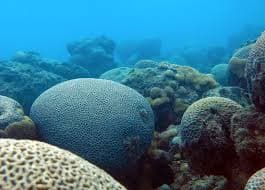
Small moray eels and lionfish live on rocky bottoms and coral reefs, where they use natural crevices and shelters to protect themselves and hunt. Both are carnivorous predators, feeding mainly on small fish and crustaceans. These species usually display discreet behavior, remaining still while waiting for prey, which helps with camouflage and hunting efficiency. Despite their relatively small size, they have effective defense mechanisms, such as the morays’ strong bite and the lionfish’s venomous spines. Small moray eels are usually solitary and do not pose a danger to humans. They belong to the order Anguilliformes, the same as eels, and to the family Muraenidae. Their bodies are long and snake-like, but they are fish. Depending on the species, their length can vary between 40 cm and 150 cm. They also have coloration patterns and spots that help them camouflage in their habitats. Moray eels are nocturnal fish, usually found near the substrate, inside tunnels and holes, and the depth varies depending on the species. In general, they feed on crustaceans and have a wide distribution around the world.
Tank species
Zebra moray
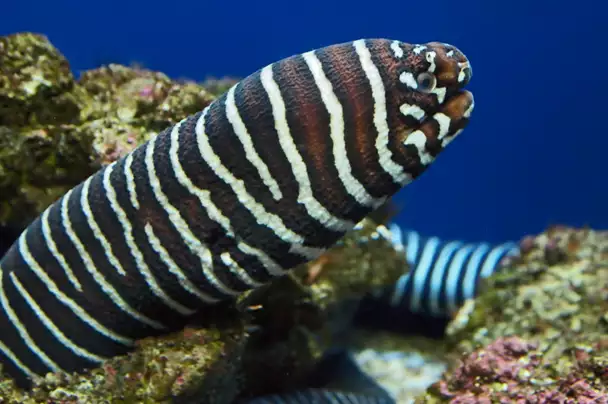
Gymnomuraena zebra
The zebra moray lives on sandy and rocky bottoms, hiding in crevices and ledges of marine reefs, at depths ranging from 3 to 50 meters. It is nocturnal in habit, and its diet includes crustaceans, sea urchins, and mollusks such as clams and other hard-shelled prey. Unlike some moray eels that have sharp teeth for catching fish, the zebra moray has flat, plate-like teeth, specialized for crushing hard shells. Its size ranges from 50 cm to 150 cm, with narrow, closely spaced dark bands, and it is harmless. Its distribution spans the Western Indo-Pacific: from the Red Sea and East Africa and the Persian Gulf to the Society Islands, north to the Ryukyu and Hawaiian Islands, and south to the Great Barrier Reef. It is also found in the Eastern Central Pacific: from southern Baja California, Mexico and Guatemala to northern Colombia, including the Galápagos Islands.
Starry moray
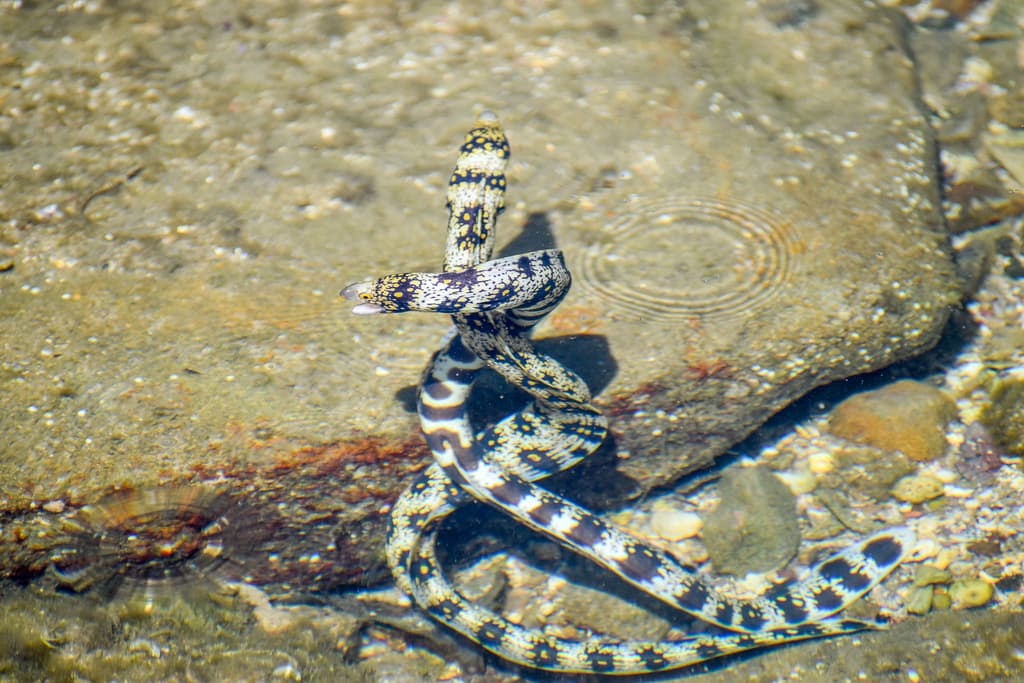
Echidna nebulosa
Snowflake moray or starry moray has a white body (Echidna nebulosa) with two rows of large dendritic black spots; black markings between the spots become irregularly linear with age. Yellow eyes. Found among rocks and coral in intertidal reef zones, also in shallow lagoons and seaward reefs, at depths of at least 10 meters. It is a benthic and solitary species, usually seen in open areas or with only its head exposed, and is also nocturnal in habit. It feeds mainly on crustaceans. Its distribution ranges across the Western Indo-Pacific: from the Red Sea and East Africa and the Persian Gulf to the Society Islands, from northern to southern Japan and the Hawaiian Islands, and south to Lord Howe Island; widespread throughout Micronesia. In the Eastern Central Pacific: southern Baja California, Mexico, and from Costa Rica to northern Colombia. It is also found in the Southeastern Atlantic.
Zebra turkeyfish
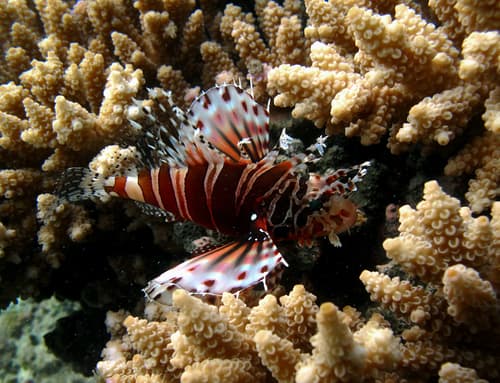
Dendrochirus zebra
Found in the Indo-West Pacific. It lives on rocky bottoms and among coral reefs, feeding on fish and crustaceans. They can reach 20 cm in length. It travels long distances and lives in small groups. Remembering that the species of lionfish that became known for starting to invade the Brazilian coast at the end of 2021 is Pterois volitans.