


%20(2).jpg&w=1920&q=75)
At the Seashore: A Boundary Between Worlds
Two worlds
The meeting between the sea and the sand forms a living boundary, where two completely different worlds touch and transform each other. This region, called the intertidal zone, is inhabited by amazing organisms that have developed unique strategies to survive both on land and in the sea. At this boundary between the terrestrial and marine worlds, everything changes all the time: sometimes it is submerged by the tide, other times it is exposed to the sun and wind. Living in this unstable environment requires resilience, adaptation, and creativity. The animals that inhabit this place have to deal with daily changes in temperature, salinity, and humidity, which makes their survival a real challenge. The composition and size of the sand grains also directly influence the types of organisms that can live there. Many of these creatures can quickly bury themselves, seeking shelter in the wetter layers of sand, where seawater can still reach. Many of the animals living in these environments, such as mole crabs, crabs, polychaetes, and some fish, are fundamental for the health of coastal ecosystems. They participate in nutrient recycling, help oxygenate the soil, and serve as food for many other species. In this way, we can infer that an environment is healthy simply by the presence of these animals.
Tank species
Goldspotted eel
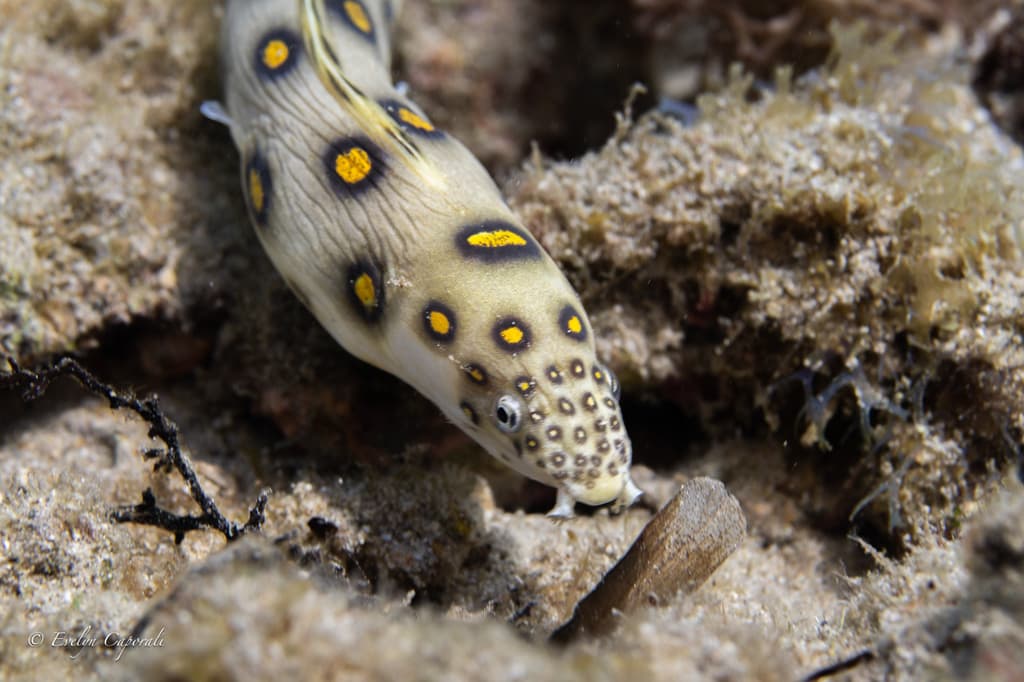
Myrichthys ocellatus
A species of fish that occur in tropical waters of the Atlantic Ocean. In Brazil it occurs from the north to the southeast. It is found in the bottom of shallow coastal waters near islands and in rocky or coral areas. It is solitary and has nocturnal habits, feeding basically of crabs and fish. Its serpentiform body can reach 102 cm in length. It is common to see the goldspotted eel with its body partially buried to camouflage itself and to catch prey that passes by.
Long-snouted seahorse
.jpg&w=1920&q=75)
Hippocampus reidi
Seahorses have tube-shaped mouths and are carnivorous. Their diet consists of plankton, small mollusks, and crustaceans such as brine shrimp. In adulthood, their prehensile tail becomes more developed, allowing them to grasp algae and corals so they are not carried away by currents. They can change color and move their eyes independently. They are difficult to spot because they adapt to their environment and camouflage themselves. Seahorses are ovoviviparous! A peculiarity is that males “get pregnant.” The female deposits her eggs into the male’s brood pouch, where he fertilizes them and carries them until birth. The offspring are born looking like miniature adults. A single male can produce between 150 and 1,200 offspring per pregnancy, depending on the species. The maximum size can reach about 17 cm.
Mole Crab
.png&w=1920&q=75)
Mole Crab
They are decapod crustaceans that inhabit sandy beach areas, using their body adaptations to dig into the sand. Their light coloration helps them camouflage, and their bodies remain almost entirely buried, leaving only their antennae exposed. They are small animals, usually measuring about 4 cm in length, and are filter feeders that feed on plankton. They are sensitive to pollutant exposure, and their presence indicates good water quality.