




%20(1).jpg&w=1920&q=75)
Discoveries
Discoveries
AquaRio is a center for marine life conservation and research. Here, we develop more than 30 studies in partnership with institutions, universities, and the Brazilian Navy. All of this is possible because part of the ticket revenue is allocated to these important projects, which contribute to the conservation and understanding of marine ecosystems. Discover some of the research being carried out here:
Tank species
Assessment of Climate Change Effects on the Developmental Physiology of Mussismilia harttii: Saving the Corals of the Future
Assessment of Climate Change Effects on the Developmental Physiology of Mussismilia harttii: Saving the Corals of the Future
Principal Investigator: Leandro Cesar de Godoy Team: Tales Fabris Chaves; Carolina Chuaste Grando; Nayara Oliveira da Cruz; Andréa Giannotti Galuppo Partnership: Federal University of Rio Grande do Sul Coral reefs are threatened by overfishing, pollution, warming, and acidification of ocean waters, leading to mass coral bleaching. In the past 30 years alone, over 50% of the world’s coral reefs have been lost. In 2019, the coral Mussismilia harttii was severely affected by bleaching, in an event unprecedented in recorded history. Bleaching, primarily caused by rising ocean temperatures, occurs due to the breakdown of the symbiosis between microalgae and corals. Depending on the intensity, this process can become irreversible, resulting in the death of the host colonies. The aim of the study, developed in partnership with AquaRio, is to understand the physiology of the development of this endangered coral species, Mussismilia harttii, using frozen sperm and in vitro fertilization under different climate scenarios. Collections will be carried out along the coast of Pernambuco, within the Coral Coast Environmental Protection Area (APA), a region seasonally affected by bleaching. Samples will then be transported to AquaRio, where a mesocosm system will simulate the environmental conditions predicted by climate change models. This will allow us to analyze survival rates under warming waters and select more resistant lineages, enabling the reintroduction of more resilient individuals into the APA, capable of surviving future bleaching events.
Hematological Assessment of the Aquatic Animal Collection at the Marine Aquarium of Rio de Janeiro

Hematological Assessment of the Aquatic Animal Collection at the Marine Aquarium of Rio de Janeiro
Principal Investigator: Aline Moreira de Souza Team: Aline Moreira de Souza; Márcia de Souza Xavier; Nayro Xavier de Alencar; Amanda de Oliveira Alcântara; Daniele Mello Cunha; André Luiz de Almeida; Victoria Carvalhal Natale; Newton Mello de Andrade Filho; Renata Mourão de Moraes; Isaque Neves Gonçalves; Tatiana Moniz Portella Lovatto; Raquel Alves Pinna; Veronica Takatsuka Manoel; Amanda Ruscy; Matheus Felix; Sérgio Santos Partnership: Fluminense Federal University (UFF) Aquariums and zoos have become essential for advancing scientific knowledge and addressing gaps in various fields such as ecology, ethology, and reproduction. However, challenges and obstacles are common when managing ex situ populations, either due to a lack of knowledge about their natural life cycles or the difficulties of maintaining these animals under human care. A fundamental aspect of ensuring animal welfare is the regular performance of laboratory tests, which support health assessments and enable more accurate diagnoses—and consequently, earlier and more effective treatments. The partnership between AquaRio and the Clinical Veterinary Laboratory at the University Veterinary Hospital Professor Firmino Mársico Filho (LABHUVET/UFF) and the Clinical Research and Molecular Diagnostics Laboratory Professor Marcílio Dias do Nascimento (LAMADIN) focuses precisely on monitoring AquaRio’s animal collection. This allows the establishment of reference parameters that indicate health status through hematological, biochemical, cytochemical, and cytological diagnostic tests. In addition to ensuring the quality of life of AquaRio’s animals, this partnership contributes to the professional training of veterinary students at Fluminense Federal University, enhancing their academic and clinical education.
Reproduction, Growth, and Ex Situ Behavior of Elasmobranchs
Reproduction, Growth, and Ex Situ Behavior of Elasmobranchs
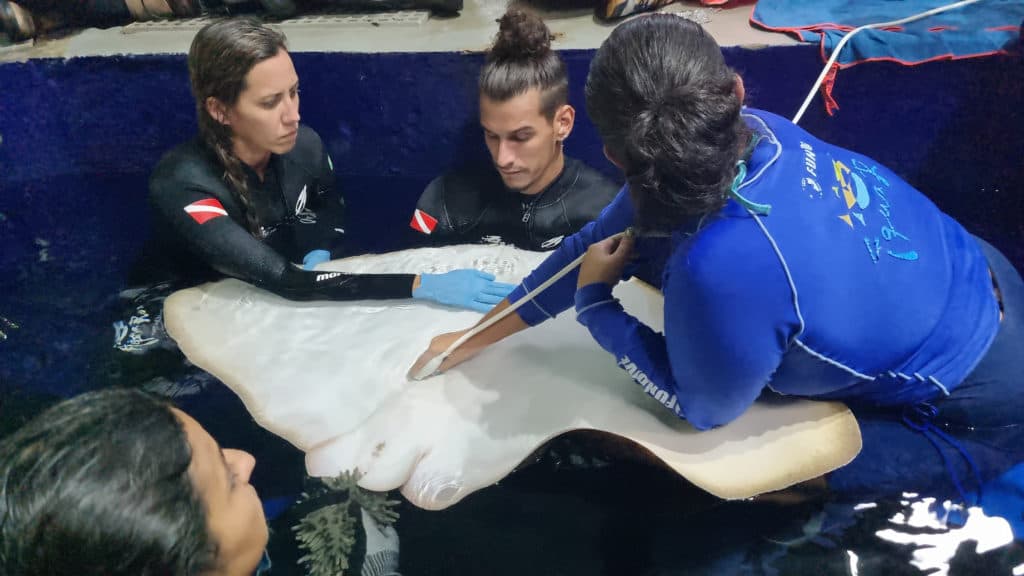
This line of research is developed in association with the Laboratory of Biology and Fisheries Technology (BioTecPesca – Institute of Biology/UFRJ), focusing on elasmobranch species of Brazilian ichthyofauna, such as the lesser electric ray Narcine brasiliensis (Olfers, 1831) and the southern stingray Hypanus guttatus (Bloch & Schneider, 1801), as well as species already recognized as threatened and with fishing bans in place, such as the spiny butterfly ray Gymnura altavela (Linnaeus, 1758). The studies associated with this research line address significant knowledge gaps about these species and respond to demands from public authorities, sectors of the production chain, and academia. They also aim at the proper awareness of the population and consumers who are directly or indirectly connected to the fishing, processing, and consumption of sharks and rays. The research line also includes studies that assess the extent of environmental impacts and their consequences for the quality of life of elasmobranchs living in degraded ecosystems. These studies allow for the characterization of metals and the expression of proteins, metalloproteins, and enzymes in different organs of fish exposed to environmental contamination, both in the wild and under human care. The research is developed in partnership with the Laboratory for Environmental Health Assessment and Promotion (Oswaldo Cruz Institute/Fiocruz). The results not only help identify the scale of environmental degradation but also provide essential data for human health and the population’s food safety.
DNA as a Tool for Seahorse Conservation
DNA as a Tool for Seahorse Conservation
Principal Investigator: Natalie Villar Freret Meurer Team: Amanda Vaccani do Carmo; Tatiane Fernández do Carmo; Gabriela Cabiró; Anderson Vilasboa; Denise Dias Partnership: Santa Úrsula University Seahorses are unmistakable fish found in coastal regions, occurring in mangroves, bays, coral reefs, rocky shores, and seagrass beds. Seahorses can be considered symbolic fish of the ecosystems in which they live. They serve as comprehensive indicators of environmental health—not only because of their relationships with various species, but also because they are charismatic and threatened animals, making them flagship species for community awareness programs. The most abundant species along the Brazilian coast is the longsnout seahorse, Hippocampus reidi Ginsburg, 1933. Despite the long history of environmental impact in Guanabara Bay, seahorse populations remain stable in the estuary, although monitoring is challenging due to the low water transparency. Environmental DNA (eDNA) is a relatively recent technique developed over the past decade, not only for microorganisms but also for macroscopic organisms such as plants and a variety of animal species. It will now be used to monitor seahorses in the bay, allowing the method to be adapted to the local population and confirming the distribution of seahorses in the surrounding mangroves.
Characterization of Seasonal Presence, Population Identity, and Behavior of the Humpback Whale (Megaptera novaeangliae) in the State of Rio de Janeiro

Characterization of Seasonal Presence, Population Identity, and Behavior of the Humpback Whale (Megaptera novaeangliae) in the State of Rio de Janeiro
Principal Investigator: Enrico Marcovaldi Team: Sergio Cipolotti; Enrico Marcovaldi; Liliane Lodi; Guilherme Maricato Partnership: Humpback Whale Institute (Instituto Baleia Jubarte) Founded in 1988 as part of the creation of the Abrolhos Marine National Park, the project was established with the mission to study and protect the remaining population of humpback whales that reproduce in Brazilian waters—at the time still considered endangered. Thanks to more than 35 years of dedicated efforts, humpback whales have now almost fully recovered in Brazil. The project, managed by the Humpback Whale Institute and sponsored by Petrobras since 1996, maintains five physical bases: Praia do Forte, Caravelas, and Itacaré in the state of Bahia; Vitória in Espírito Santo; and Ilhabela in São Paulo. It also operates in other regions through partnerships with similar institutions, public agencies, and the private sector. The work is structured around three core areas—research, education, and conservation policy—to ensure the species' full recovery. The humpback whale (Megaptera novaeangliae) is one of the great migratory whales that visits the Brazilian coast during winter and spring to mate, give birth, and nurse their calves. They travel along the southern and southeastern coasts up to the Abrolhos Bank, their main concentration area. This project focuses on monitoring the whales’ migratory patterns, aiming to identify individuals and map their distribution along the southeastern coast—especially in the state of Rio de Janeiro. The data generated will support more effective conservation plans. Additionally, the study creates opportunities to promote sustainable whale watching tourism and to raise public awareness about cetaceans along the coast of Rio de Janeiro.
ECOSHARK - Ecology, Conservation, and Monitoring of Sharks in Rio de Janeiro
ECOSHARK - Ecology, Conservation, and Monitoring of Sharks in Rio de Janeiro
Principal Investigator: Fernanda de Oliveira Lana Team: Fernanda de Oliveira Lana; Leonardo Flach; Mariana Alonso Partnership: Instituto Boto Cinza The population decline of several pelagic shark species has raised serious concerns regarding their conservation. Their low recovery potential - directly related to life history traits such as slow growth, late sexual maturity, and low fecundity - makes the study of these populations a priority for their preservation. However, the migratory patterns of these animals make monitoring difficult, as they move along the South American coast or even cross oceans seasonally. This project, developed in partnership with UFRJ, aims to determine movement patterns and spatial ecology of these species through telemetry, and to assess the local population structure of sharks along the coast of Rio de Janeiro. The study will focus on species known to occur in the region, such as hammerhead, sand tiger, mako, blacktip, and tiger sharks, among others. The research will employ satellite tagging—a still-rare but innovative method along the Brazilian coast—which has made it possible to gather valuable information on depth distribution, temperature preferences, and migratory movements of various shark species worldwide. In addition to being minimally invasive and low impact, with extremely low mortality rates (usually only associated with the capture process), electronic tags allow for remote monitoring of tagged animals, providing unprecedented insights into their life cycles and migratory behaviors. These data will be essential for developing more effective policies to save these sharks from the threat of extinction.